

Lynne Watts
Author & Counselor

Conquering Test Anxiety is Possible
As the school year winds down, anxiety ramps up. There is anxiety over passing to the next grade and completing projects. But most of all there is anxiety over testing.
The best way to eliminate test anxiety, is to put testing in it’s proper perspective. In an education world where testing, test scores and data have taken on a life of it’s own, this is a difficult thing to do. The purpose of tests is to provide information; information on what an individual student has learned and what they have not learned so that future teaching can begin from that point.
Instead tests are used to evaluate and assess teachers and even entire schools as to whether or not they are missing the mark. Because so much is at stake, this increases everyone’s anxiety and this emotion gets passed on to students.
Parents as well can increase anxiety by putting too much emphasis on testing, rather than on the learning experience itself. A student who values and is engaged in the learning process throughout the year will naturally be prepared for doing well on a test. Excessive focus on tests as a gateway to the future, whether passing to the next grade or admission to the college of their dreams can create undue stress.
Given that despite our best efforts, children may become stressed out over upcoming testing, what are the best ways to deal with anxiety when it rears it’s ugly head?
Six Tips to Conquer Test Anxiety
- First and foremost acknowledge the feeling rather than brushing it off or providing a distraction. Instead of, “Don’t worry. You are so smart, you’ll do fine.” Try, “You are worried about passing the test? Tell me about that.” Help the child identify how he knows he is worried both physically (heart beating faster, shallow breathing for instance) and mentally (I keep thinking about not passing, blanking out answers etc.)
- Create a positive image of who the child wants to be going into the situation.
- “I want to be calm and confident.”
- “I want to be focused and know the answers to the test.”
- Teach some simple breathing skills to calm down the physical symptoms, so he can begin working on the mental skills. Point out how calming the breathing calms the body. An easy one is box breathing:
- Breathe in for 4 counts
- Hold for 4 counts
- Breathe out for 4 counts
- Hold for 4 counts
- Repeat
- Identify and challenge the thoughts that are creating the anxiety by providing a different thought pattern to replace the anxiety producing thoughts. Creating a simple repeatable phrase that the child can learn and repeat when they feel the worry starting is helpful. Instead of thinking “what if” change the thought to “what is”. For example instead of thinking “What if I get the test and don’t know any answers?” change the thought to “I’ve worked hard all year and I choose to be calm and confident of my ability.”
- Create a plan that the child can follow on his own: “Whenever I notice I am getting stressed out, I will:
- Remember my positive outcome: Who I want to be. How I want to feel.
- Stop and breathe
- Repeat my phrase
- Check in to make sure the plan is working and tweak the plan if it is not. Create a positive expectation that the anxiety is something that the child can be in charge of rather than something to avoid.
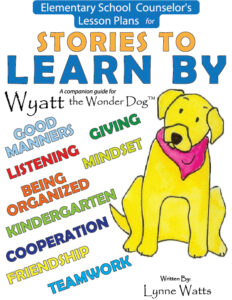
The Elementary School Counselor’s Lesson Plans for Stories to Learn By
Children learn best through stories and The Elementary School Counselor’s Lesson Plans for Stories to Learn By is a companion book especially designed for school counselors and educators who use the Wyatt the Wonder Dog Picture Book Series to teach social emotional skills. It includes discussion questions, activities, games, ASCA aligned lesson plans, reproducible coloring sheets, word searches, pre-test/post-test assessments and more for each of the nine Wyatt the Wonder Dog Books.

About Lynne Watts
Lynne Watts is a veteran elementary school counselor and the creator of the Wyatt the Wonder Dog series. Her mission is to provide educators with engaging, child-friendly tools that build character and social-emotional skills in the classroom.

Don’t Give Up Yet! Teaching Kids to Manage Frustration

Focus Power: 7 Simple Ways to Help Kids Improve Attention

Stop–Think–Choose: A Simple Impulse Control Strategy for Elementary Students

Better Behavior Plans: A Guide for School Counselors

Healthy Friendships: Boundaries Every Child Should Know

Friendship Problems? 7 Skills Kids Need to Solve Conflicts
How to Make Friends: 3 Simple Skills Every Child Needs

Everyone Belongs: 10 Ways Kids Can Be a Belonging Builder

The Friendship Formula: 7 Qualities of a Great Friend
Creating a Culture of Creativity at School
Teaching Kids to Think Creatively: 7 Strategies for Elementary School Counselors

Think Outside the Box: Teaching Creative Thinking Skills to Elementary Students

Critical Thinking Activities for Elementary School Counselors

Critical Thinking: Helping Students Think, Not Just Answer

School Counselor Self-Care: 5 Essential Ways to Renew Your Energy and Avoid Burnout

Start Strong: Five Ways Counselors Plan for a Fantastic School Year

The Science of Encouragement: What Elementary School Counselors Need to Know About Positive and Negative Comments

Using Journals in Elementary School Counseling: Simple Strategies for Big Emotional Learning

Unlocking Resilience: How Curiosity Builds Stronger, Braver Elementary Students

Caring for the Caregiver: Self-Care Strategies for Counselors During Stressful Times

School Counselor Conference Success: Tips for Learning, Networking, and Growth

Journaling for Kids: Prompts that Build Emotional Growth and Confidence

The Burnout Fix for School Counselors: How to Set Healthy Boundaries Without Guilt

School Counseling and Burnout: Why Boundaries Matter More Than Ever

Prepared to Lead: Teaching Elementary Students the Power of Being Ready

Journaling : A Powerful School Counseling Tool for Emotional Growth and Self-Reflection

Why Boredom Is Good for Kids: A School Counselor’s Guide to Building Creativity and Independence
From Overwhelmed to Empowered: Practical Burnout Solutions for School Counselors

From ‘I Have to Get It Right’ to ‘I Can Try Again’: Tackling Perfectionism in Kids

Teaching Kids to Get Better at Getting Along

Improve Communication Skills and Resolve Conflicts with Kids

The Power of Storytelling in Elementary Counseling: Helping Kids Learn Life Skills That Stick