

Lynne Watts
Author & Counselor

Have you ever watched a student react to a situation almost before they had time to think about what they were doing?
A student grabs a toy from a classmate. Another blurts out an angry response. A child becomes frustrated with an assignment and immediately gives up. A student gets upset during a game and says something hurtful before thinking about the consequences.
These moments are opportunities to teach impulse control, self-regulation, emotional regulation, and responsible decision-making.
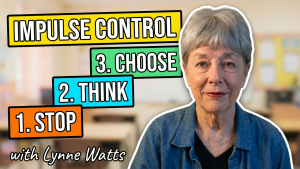
One simple strategy elementary school counselors can teach is Stop–Think–Choose. This easy-to-remember strategy gives children a mental pause between what happens and how they respond.
What Is Impulse Control?
Impulse control is the ability to pause before acting and think about what to do next.
Children naturally experience strong emotions and impulses. When a child is angry, frustrated, excited, disappointed, or worried, the first reaction may not always be the best response.
Impulse control does not mean that children should stop having emotions. Instead, children learn to recognize their feelings and choose a response rather than automatically reacting to an impulse.
For elementary students, impulse control can look like:
- Pausing before responding when someone says something hurtful
- Raising a hand instead of blurting out an answer
- Taking a breath before reacting when frustrated
- Thinking before joining an argument
- Waiting for a turn
- Choosing words carefully when angry
- Considering the consequences of a decision
- Asking for help instead of immediately giving up
- Walking away from a conflict instead of escalating it
Learning impulse control is an important part of self-regulation and social-emotional learning (SEL).
Why Teach Children an Impulse Control Strategy?
Telling a child to “just stop and think” can be difficult when they are already experiencing a strong emotion.
That is why children benefit from having a specific strategy they can practice and remember.
Stop–Think–Choose gives students a simple mental sequence to follow when they experience a challenging situation.
The goal isn’t to eliminate impulsive thoughts or emotions. The goal is to help children learn that they can pause and make a choice about what they do next.
What Is the Stop–Think–Choose Strategy?
The Stop–Think–Choose strategy teaches children to create a small pause between a situation and their response.
The Three Questions to Teach Students
For younger elementary students, keep the strategy especially simple.
Teach students to remember three questions:
1. STOP: What is happening?
Pause and notice the situation.
2. THINK: What could I do?
Identify possible choices.
3. CHOOSE: What is the best choice?
Choose a response that is safe, respectful, and helpful.
A counselor might have students repeat:
STOP: Pause.
THINK: What are my choices?
CHOOSE: What is the best choice?
The more students practice the language, the more likely they are to remember it when they actually need it.
Children don’t develop impulse control simply because adults tell them to “think before you act.”
They need practice, modeling, repetition, and simple strategies they can actually remember when emotions are high.
Stop–Think–Choose gives students a mental pause between a situation and their response.
That pause can create an important opportunity:
Instead of reacting, I can think.
Instead of acting on an impulse, I can make a choice.
Instead of asking, “What do I feel like doing?” I can ask, “What is the best thing to do next?”
That is the beginning of stronger self-regulation, impulse control, emotional regulation, problem-solving, and responsible decision-making.
For elementary school counselors, it is a small strategy that can make a big difference.
Click here to watch video
About Lynne Watts
Lynne Watts is a veteran elementary school counselor and the creator of the Wyatt the Wonder Dog series. Her mission is to provide educators with engaging, child-friendly tools that build character and social-emotional skills in the classroom.

Don’t Give Up Yet! Teaching Kids to Manage Frustration

Focus Power: 7 Simple Ways to Help Kids Improve Attention
Stop–Think–Choose: A Simple Impulse Control Strategy for Elementary Students

Better Behavior Plans: A Guide for School Counselors
Healthy Friendships: Boundaries Every Child Should Know

Friendship Problems? 7 Skills Kids Need to Solve Conflicts
How to Make Friends: 3 Simple Skills Every Child Needs

Everyone Belongs: 10 Ways Kids Can Be a Belonging Builder

The Friendship Formula: 7 Qualities of a Great Friend

Creating a Culture of Creativity at School
Teaching Kids to Think Creatively: 7 Strategies for Elementary School Counselors

Think Outside the Box: Teaching Creative Thinking Skills to Elementary Students

Critical Thinking Activities for Elementary School Counselors
Critical Thinking: Helping Students Think, Not Just Answer

School Counselor Self-Care: 5 Essential Ways to Renew Your Energy and Avoid Burnout

Start Strong: Five Ways Counselors Plan for a Fantastic School Year

The Science of Encouragement: What Elementary School Counselors Need to Know About Positive and Negative Comments

Using Journals in Elementary School Counseling: Simple Strategies for Big Emotional Learning

Unlocking Resilience: How Curiosity Builds Stronger, Braver Elementary Students

Caring for the Caregiver: Self-Care Strategies for Counselors During Stressful Times

School Counselor Conference Success: Tips for Learning, Networking, and Growth

Journaling for Kids: Prompts that Build Emotional Growth and Confidence

The Burnout Fix for School Counselors: How to Set Healthy Boundaries Without Guilt

School Counseling and Burnout: Why Boundaries Matter More Than Ever

Prepared to Lead: Teaching Elementary Students the Power of Being Ready

Journaling : A Powerful School Counseling Tool for Emotional Growth and Self-Reflection

Why Boredom Is Good for Kids: A School Counselor’s Guide to Building Creativity and Independence
From Overwhelmed to Empowered: Practical Burnout Solutions for School Counselors

From ‘I Have to Get It Right’ to ‘I Can Try Again’: Tackling Perfectionism in Kids

Teaching Kids to Get Better at Getting Along

Improve Communication Skills and Resolve Conflicts with Kids

The Power of Storytelling in Elementary Counseling: Helping Kids Learn Life Skills That Stick